gview 模板引擎支持两种 layout 模板布局方式:
define+template方式include模板嵌入方式
这两种方式均支持对模板变量的传入。
define + template
由于 gview 底层采用了 ParseFiles 方式批量解析模板文件,因此可以使用 define 标签定义模板内容块,通过 template 标签在其他任意的模板文件中引入指定的模板内容块。 template 标签支持跨模板引用,也就是说 define 标签定义的模板内容块可能是在其他模板文件中, template 也可以随意引入。
warning
注意:
- 为嵌套的子模板传递模板变量时,应当使用:
{{template "xxx" .}}的语法。 - 模板文件的后缀名,要跟
define template文件的后缀名保持一致。
使用示例:
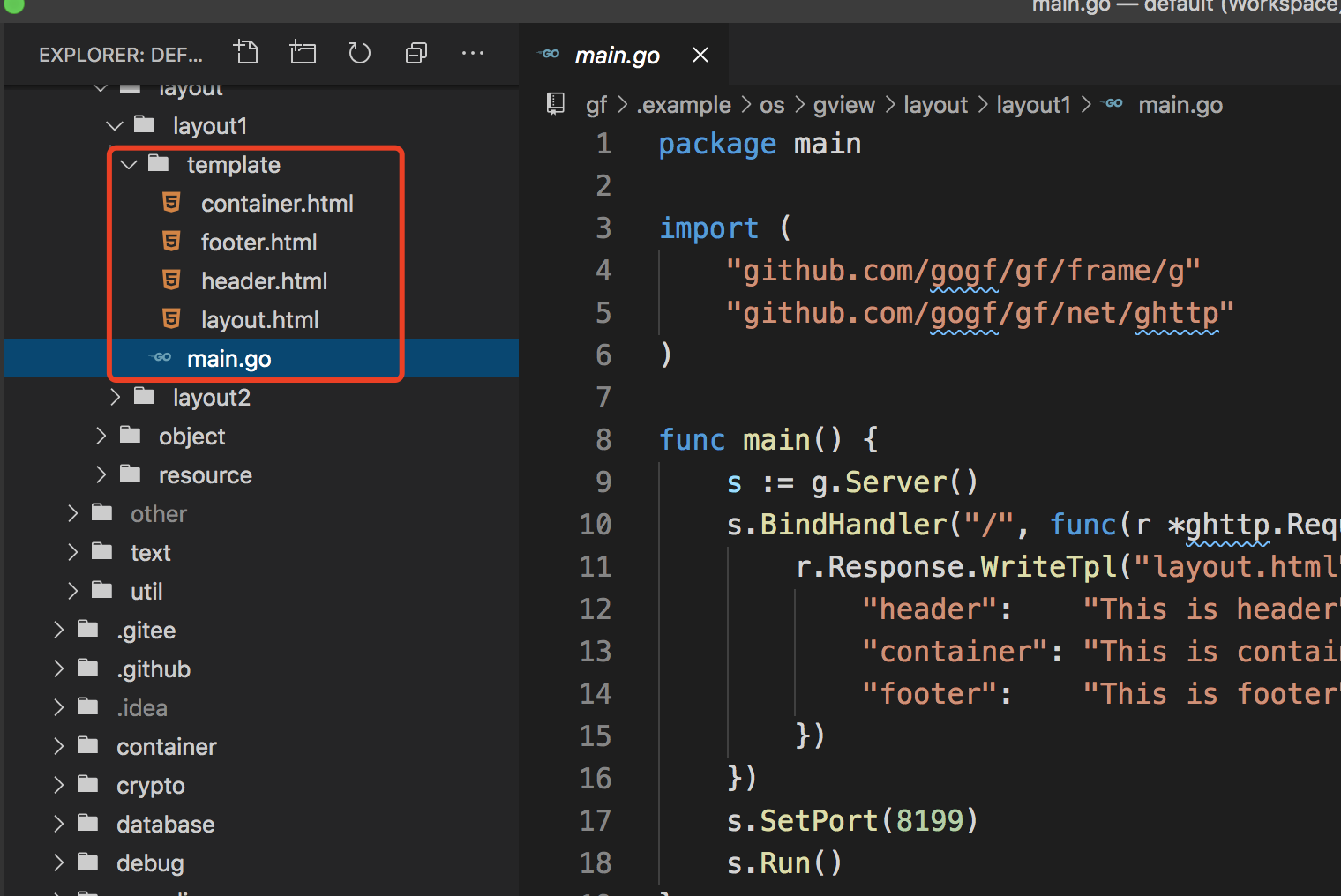
layout.html
<!DOCTYPE html>
<html>
<head>
    <title>GoFrame Layout</title>
    {{template "header" .}}
</head>
<body>
    <div class="container">
    {{template "container" .}}
    </div>
    <div class="footer">
    {{template "footer" .}}
    </div>
</body>
</html>
header.html
{{define "header"}}
    <h1>{{.header}}</h1>
{{end}}
container.html
{{define "container"}}
<h1>{{.container}}</h1>
{{end}}
footer.html
{{define "footer"}}
<h1>{{.footer}}</h1>
{{end}}
main.go
package main

import (
    "github.com/gogf/gf/v2/frame/g"
    "github.com/gogf/gf/v2/net/ghttp"
)

func main() {
    s := g.Server()
    s.BindHandler("/", func(r *ghttp.Request) {
        r.Response.WriteTpl("layout.html", g.Map{
            "header":    "This is header",
            "container": "This is container",
            "footer":    "This is footer",
        })
    })
    s.SetPort(8199)
    s.Run()
}
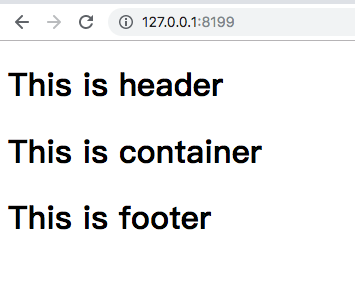
执行后,访问 http://127.0.0.1:8199 结果如下:
include 模板嵌入
当然我们也可以使用 include 标签来实现页面布局。
warning
注意,为嵌套的子模板传递模板变量时,应当使用: {{include "xxx" .}} 的语法。
使用示例:
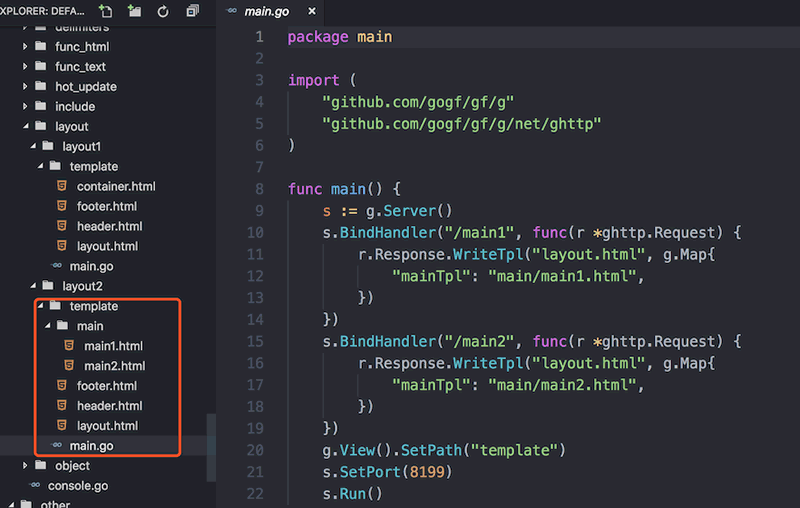
layout.html
{{include "header.html" .}}
{{include .mainTpl .}}
{{include "footer.html" .}}
header.html
<h1>HEADER</h1>
footer.html
<h1>FOOTER</h1>
main1.html
<h1>MAIN1</h1>
main2.html
<h1>MAIN2</h1>
main.go
package main

import (
    "github.com/gogf/gf/v2/frame/g"
    "github.com/gogf/gf/v2/net/ghttp"
)

func main() {
    s := g.Server()
    s.BindHandler("/main1", func(r *ghttp.Request) {
        r.Response.WriteTpl("layout.html", g.Map{
            "mainTpl": "main/main1.html",
        })
    })
    s.BindHandler("/main2", func(r *ghttp.Request) {
        r.Response.WriteTpl("layout.html", g.Map{
            "mainTpl": "main/main2.html",
        })
    })
    s.SetPort(8199)
    s.Run()
}
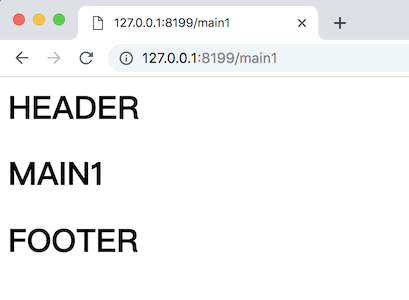
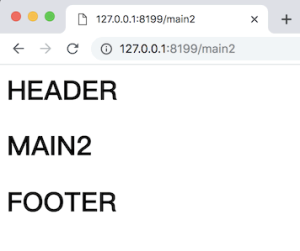
执行后,访问不同的路由地址,将会看到不同的结果: